| |||||||
| |||||||
|
|
Book Review: Stamford Bridge Speedway 1928 to 1932
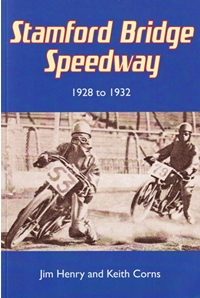
Until recently, few of the 40,000 supporters who regularly attend Chelsea Football Club's matches at Stamford Bridge would have known that the stadium once hosted another successful sporting enterprise. Between the wars, the venue was home to the Stamford Bridge Brigands, a speedway team whose story is now being commemorated in two ways: through a new leisurewear range launched by the football club and by the publication of Stamford Bridge Speedway - 1928 to 1932 from London League Publications. Authored by Jim Henry and Keith Corns - both respected writers in their own right - the book offers a meticulously researched account of speedway's formative years in Chelsea. Stamford Bridge staged its first meeting in May 1928, following practice sessions on the oval track installed around the football pitch. To protect the pitch, a fence was unusually erected along the inside line of the track. The 1928 season focused on individual and handicap racing, featuring star riders such as Roger Frogley, Billy Lamont and Sprouts Elder. Meetings were held twice weekly, with crowds reaching up to 45,000 when leading names appeared. Despite the passage of nearly a century, the book provides remarkable detail, reflecting the authors' extensive research and dedication. Team racing was introduced in 1929, a pivotal development that enabled the creation of leagues and cup competitions, ensuring the sport's longevity beyond the novelty of individual contests. Stamford Bridge entered the Southern League that year, finishing top of the 11-team competition. Initially staged over six heats, meetings expanded to nine as popularity grew. The scoring system differed from today's conventions, awarding four points for a win, two for a second and one for third. Indicative statistics compiled by the authors highlight Gus Kuhn, Colin Ford and Wal Phillips as leading scorers for the Stamford Bridge side. The 1930 season saw the team rebranded as the Brigands, with star rider Frank Arthur recruited to lead the attack. The track was widened and rolling starts were introduced, though these proved problematic with frequent false starts. Despite strong individual performances, the team failed to secure silverware that year. For 1931, new riders such as Keith Harvey, Dick Smythe and Bill Stanley joined the squad. The Brigands finished second in the Southern League, though the authors suggest a more consistent team selection might have yielded even greater success. The final chapter of Chelsea's speedway story came in 1932, when the Brigands competed in the newly formed National League, comprising clubs from both the Southern and Northern leagues. London remained the sport's hub, with teams from Wembley, Crystal Palace, Wimbledon, West Ham and Clapton among the entrants. Stamford Bridge experimented with a novel starting mechanism involving a car, cables and a spring-loaded gun, though this proved unsuccessful. The Brigands triumphed in the National Speedway Association Trophy after completing an 18-meeting programme, but their league campaign was less fruitful, finishing behind Wembley, Crystal Palace and Belle Vue. Ultimately, stadium owners opted to replace speedway with greyhound racing, judging it a more profitable venture as speedway's initial popularity had declined. The book spans 152 pages and includes 30 photographs, rider profiles and a detailed statistical section - an invaluable resource for enthusiasts and historians alike. You can order your copy at London League Pubications.
This article was first published on 1st December 2025
|
||||||
| Please leave your comments on this article (email address will not be published) | |||||||